Friday, 24 February 2017

The Raid to Rescue Debbie

In this scene, we see the Comanche camp of tepees, this is well-known iconography of the Native Americans in the western genre. Along with the tepees we see the hides of animals, skulls of animals they have successfully killed, and blankets with typically Native American designs. The Natives are also dressed as we expect them to be dressed. They have elaborate headpieces, long dark hair secured in plaits, and the men aren’t wearing any tops. This suggests that they are ‘uncivilised’ compared to the rangers who are fully clothed, complete with jackets and hats.

By scalping Scar, Ethan breaks from the generic conventions of the western, in that it is common for the natives to scalp westerners to deter them from crossing them. Instead, we see a westerner scalping a native, this makes us question Ethan’s attitude towards being a Cowboy. We also see Ethan and the other rangers challenging the Cowboy Codes that Gene Autry created. By charging in guns blazing, they break the first code that, “the Cowboy must never shoot first, hit a smaller man, or take unfair advantage.” The Natives shoot back at them in defence, this is justifiable as they were attacked.


By charging into the natives’ camp, we see a symbolisation of the idea that the Wild West will be tamed by civilisation. The rangers (a group enforcing the law), are punishing the tribe for the capture of Debbie, and as such they are ‘justified’ in their actions. However, we also see that they go too far. This is shown when they have charged through the camp, and they turn to charge again, unnecessarily, on the Captain’s orders. It is interesting that the Captain is also the Reverend. As a Reverend you would expect him to be tolerant of others and averse to violence. Yet here we see him leading a charge and potentially wounding women and children. 

Thursday, 23 February 2017

Ethan saves Debbie in 'The Searchers'

Within the film ‘The Searchers’, the storyline of retrieving Debbie from the Comanche tribe proves to have an impact not only for the supporting characters (such as Mr and Mrs Jorgensen’s family) but also Ethan, the protagonist.

The stereotypical viewpoint of the American West and its portrayal within cinematography is challenged throughout the film. As Frederick Jackson Turner’s hypothesis suggests that the ‘experience of the frontier and the expansion West leads to a memory of civilisation advancing which met declining savagery’ was a primary factor that contributed to the stereotypical cowboy vs Native Indian films,, we do not see this clearly within this film.

Although Ethan respects their rituals and beliefs to an extent, which is seen clearly when shooting the recently deceased tribe member between the eyes, disturbing his journey onto the next life and leaving him to “remain wandering forever between the winds”. However, this goes against the stereotype of the American West identity being seen as expanding West and introducing the Comanche tribe to a mass civilisation instead of a ‘savage’ lifestyle, which is also not the main focal point. His reasoning for going against the tribe is to retrieve Debbie from them after she was kidnapped by the tribe leader.

Upon realisation that Debbie has in fact become part of the tribe and accepted her new way of life and does not wish to return home with him at first, Ethan deems her as ‘She ain’t white’ due to the disgust of integrating herself with the Comanche. This questions the myths of American West lifestyle of the man always ‘rescuing’ the women whereas in this case the woman does not wish to be rescued at all, or at least for now within the film.

In relations to Gene Autry’s ‘Cowboy Code’, he goes against these so-called commandments of ‘respecting women, parents, and his nation’s laws’ and instead follows his own ideas and intentions by rescuing Debbie regardless as to whether she is actually a ‘person in distress’.

Following this, as the film concludes, we see that Ethan rescuing Debbie after successfully wounding and killing members of Scar’s tribe and picks her up as seen in the still image (above). By fulfilling his duty of retrieving Debbie without force and instead picking her up in his arms above his head, it can suggest that it was a personal remembrance that overshadows his own views of murdering her due to going against his beliefs of Debbie becoming one of the tribes woman and instead remembering her as if she were the little girl he looked after all the years before this occurred and takes her home in his arms to Mr and Mrs Forgensen.


Source:
Autry, G., ‘Cowboy Code’, http://www.geneautry.com/geneautry/geneautry_cowboycode.html, 23rd February 2017.
The Searchers, John Ford, C.V. Whitney Pictures, 1956.
Pippin, R. B., “What is a Western? Politics and Self Knowledge in John Ford’s ‘The Searcher’s’”, The University of Chicago Press, (2008).

Monday, 20 February 2017

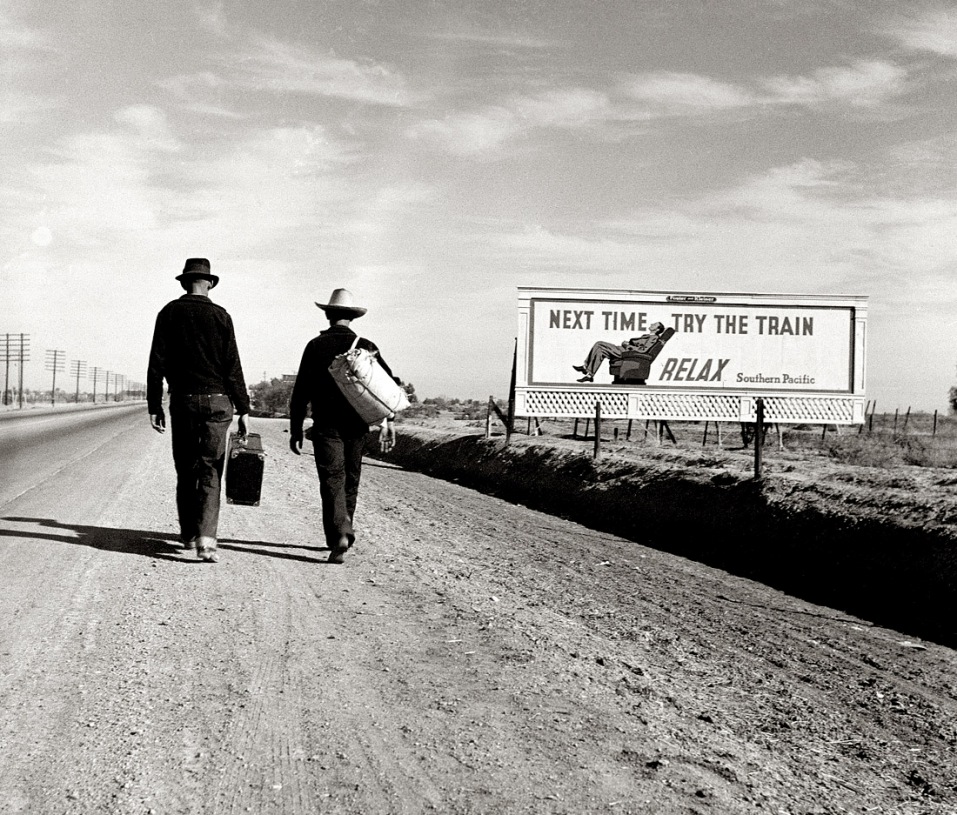
Dorothea Lange-Towards Los Angeles


Dorothea Lange ‘Towards Los Angeles’ 1937

I have chosen this image as it captures a number of aspects related to last week’s lecture and the course as well as being a powerful and an image that is somewhat appealing to the eye.

The obvious power within this image is the irony. At the left side of the image we see two men walking with luggage along a long straight. This gives the viewer the impression that they are travelling somewhere far by foot. The irony, of course, lies on the right side of the image as a billboard reads ‘Next time try the train. Relax’. This is important as it contrasts the other side of the picture. Dorothea Lange was iconic in capturing images of the depression and this is a somewhat different take on her other work which often pulls on the heartstrings and is much more raw. The fact that these two men must walk all the way to Los Angeles rather than take the train plays well to the idea of Depression photography. The men clearly do not have the funds to be able to afford to use the train and so must walk to Los Angeles.

This image is also interesting as it plays into ideas of the American Dream and the perfect victim, as Lawrence Levine writes about in his article. It plays on ideas of the American Dream with the idea of new found wealth in a new found country. This is because the railroads were still a relatively new invention that were mainly used by more privileged members of society. While this wasn’t just for the rich and trains weren’t particularly expensive, it is a luxury that many blue collar workers during the depression would aspire to use-constantly seeking a self made wealth and playing to the American Dream’s ethos of aspiration and social mobility.


This also plays well to Levine’s idea of a ‘perfect victim’. This is the sense that imagery somewhat victimizes the people who are captured but is also somewhat harmless as despite these Depression images being very raw and emotional, it is simply a short insight for a purpose. The people captured still went about their everyday lives. Levine writes, “they also continued, as people always must, the business of living. They ate and they laughed, they loved and they fought, they worried and they hoped … they filled their days, as we fill ours, with the essentials of everyday living.” So despite these images somewhat being exploitative at working class economic despair, in reality it is often the way the image has been taken, background, and timing that convey this message rather than the actual people. There’s no telling what the men’s distance is away from Los Angeles or their economic status. It is only assumed by the contrasting irony of the billboard, again reinforced by the caption of this image, suggesting Los Angeles is somewhat of a distance away. This shows that Dorothea Lange does somewhat play to that Perfect Victim illusion that Lawrence Levine talks about.

Christmas Dinner in Iowa - 1936


This is a photograph taken by Russell Lee in Iowa in 1936. The image shows children crowded around a table in a small shack eating Christmas Dinner. I chose this image because it shows how the extreme poverty caused by the great depression meant that the children hardly had enough money and food for Christmas.

The image raises a lot of questions, such as where are the parents in the image and why are there empty chairs in the image. Many questions are answered in an article from Sioux city journal, where Helen Pauley Hopkins who is the child closest to the camera in the picture, is tracked down later in life and asked about the photograph.

In the article, Helen explains that her family barely had enough food and money to get by and as soon as they could the children found work. She talks about how she and her siblings used to wait for their father to return home from work each day to eat with him as a family. Looking back on her childhood retrospectively she realises that her parents went without regularly to make sure that the children ate well and had enough to survive in the depression. She also explains that she lost two siblings during the depression, one as a baby and one before the age of four. This could be why the parents put so much effort into making sure that the others had enough.

The image was probably taken without the parents in frame to focus on the struggle of children at the time, which is partially why the photo hits so hard. The conditions that the children are living in is equivalent to the hardships faced by many in modern day slums and the fact that this was taken in America less than a century ago shows just how hard hitting the crash was.

This also shows that the idea of the American Dream was stopped dead in its tracks by the Great Depression and instead of trying to achieve the perfect life for them and their families, many Americans were just living each day as it came in hopes of survival.


World's Highest Standard of Living - Margaret Bourke White

Margaret Bourke White “World’s Highest Standard of Living” 1937

Within this photograph, there are a variety of elements that engage with the viewer as to how accurate the Great Depression had an impact on Americans themselves. The advertisement board behind the people states that 'There's no way like the American Way' when discussing the world's highest standard of living. Segregation was still occurring within America at this time, and the contrast between the living standards of the African-Americans compared to the White family seen within the advertisement potentially suggests that the iconic family life and the 'American Way' of high standards of living was not applicable to African-Americans and therefore created tension within society.

In Levine's 'Photography and the History of American People in the 1930s and 1940s' paper, he states that President Hoover said "no one is starving" within America and that the American people had recovered from this decade of poverty and unemployment. However, we can see that within this juxtaposition that in 1937 the Great Depression still had long lasting implications on the people as seen above. While these people are queuing in a line for bread, we can analyse their clothes, their body language which gives further detail as to how these people are suffering. The men within this photo are all wearing hats, long coats and have shoes that are fit for purpose alongside this, are the few women wearing fur coats (far left) and kitten heel boots (right) and therefore, it raises the questions of to what extent are the people of America actually suffering from the Great Depression? Are they below the poverty line? Are the people in these photos all unemployed or do some of them work within the Alphabet Agencies or elsewhere?

Levine continues in his journal that the people of America became known as "unemployed men, desperate mothers and ragged children" within society who had not successfully overcome the misfortune of the Depression. It is well-known that prior to this photo being processed in 1937, that America was financially unstable with unemployment at 23.6% in 1932, the industrial stocks lost 80% of their value and that 40% of American banks had failed significantly and had not recovered. 
This is reinforced with Levine's analysis that unemployment remained 'critically high' until America entered World War Two in 1941. Although it solved the unemployment crisis within the 1930s, the aftermath of the war remained unclear as to what America's next step would be.

To conclude, the lack of emotions within the photograph clearly suggests that these people are not living the 'American Way' of lifestyle, since their own lifestyle is disorganised with no definitive outcome in the near future, by the majority of the people not directly facing the photographer Margaret Bourke White as she photographed on behalf of 'Fortune' magazine, suggests that they are ashamed of the life they lead and do not wish to be seen by the wider audience as to how they live.


Sources: 
Levine, L.W., "Photography and the History of American People in the 1930s and 1940s" in 'The History and the Icon', (London, University of California Press, 1988). 
White, M. B., "World's Highest Standard of Living", 1937.

Poor Whites, Georgetown, D.C.

Poor Whites, Georgetown, D.C.
Carl Mydans, 1935.


The solemn expressions on these children’s faces evoke emotion within the viewer of the photograph. They appear dishevelled and ragged, demonstrating how little their parents had to clothe and clean them properly. This is emphasised by the lack of shoes and ripped dress on the older girl, and the dirt on the younger girl’s face. Levine notes that “we are not prepared to see the symbolic victims we have become familiar with do anything but appropriately despairing, to suffer – with admirable dignity perhaps – but to suffer nonetheless.” We can see truth in his statement visualised in this photograph as we expect children to be playing, not sat in a doorway looking as though they are suffering. However because of the nature of the project carried out by the Farm Security Administration, what we are expecting to see alters to suit the context and as such, we are not surprised by the visible suffering of these children.

By not attaching a name to these children, as many of the photographers failed to do for their subjects, and instead referring to them as “Poor Whites” Mydans is detaching them from their individuality. In doing so, they created a unique collection of historical references. This is also suggested by Levine when he says, “it was precisely from the photographers’ attempts to picture their subjects not as individuals but as components of a larger context.”

These children represent family poverty that was prevalent during the Great Depression. This could also indicate that the children’s parents are believers in the American Dream, as so many were during this hard time, as they would want to stay strong and positive, despite everything that life has thrown at them. 

Monday, 13 February 2017

Visualising the American West

'Attack on a Wagon Train' painted by Charles Marion Russell in 1902, shows the resistance of the Native Americans towards the new European settlers who are invading their land and distorting the land. Russell is known to be a Romanticism artist, often depicting a sense of storytelling through his visualisation of accounts that he authored.

This oil painting symbolises the communication between the Natives and the newcomers suggesting that the new community that is being established are not welcomed. The pioneers who are travelling West to enhance and experience unclaimed land are in the distance of the painting suggesting they are not the significant centerpiece to this painting. By enforcing natural elements such as lighter colours on the Native Americans within the painting, it shows the body language of the Native Americans as they begin to attack as it shows the masculinity of the men who are trying to succeed in preventing the pioneers establishing a village or town. Not only this, the painting could also suggest that the Wild West is not willing to conform or to at least adapt to the views of the settlers by cultivating the land due to the difference in physicalities such as the mountains and uneven land and that the Native Americans are protecting it from harm.


However, this painting by Bradley Schmehl shows that the American Frontier has become successful and the Native Americans have been unable to protect their communities and land from the settlers. The settlers have adapted to the vast differences of landscapes within America and have built railways, used the land for its natural resources (such as wood which can be seen in the cart of the train) and created a vast and wide communication across the land from East to West which is accessible due to the industrialisation of America during this time.

Although Schmehl is not contemporary to the time that this occurred, he provides an interesting analysis of the American West and how it is symbolised. By visualising the impact of Westernisation on the Natives, he is able to create a symbolism of resistance and force within a painting to create an alternative view on the American West.


Sources: https://uploads7.wikiart.org/images/charles-m-russell/attack-on-a-wagon-train-1902.jpg
http://www.charlesmarionrussell.org/
http://bradleyschmehl.com/index.php/gallery/
http://bradleyschmehl.com/wp-content/uploads/wppa/25.jpg