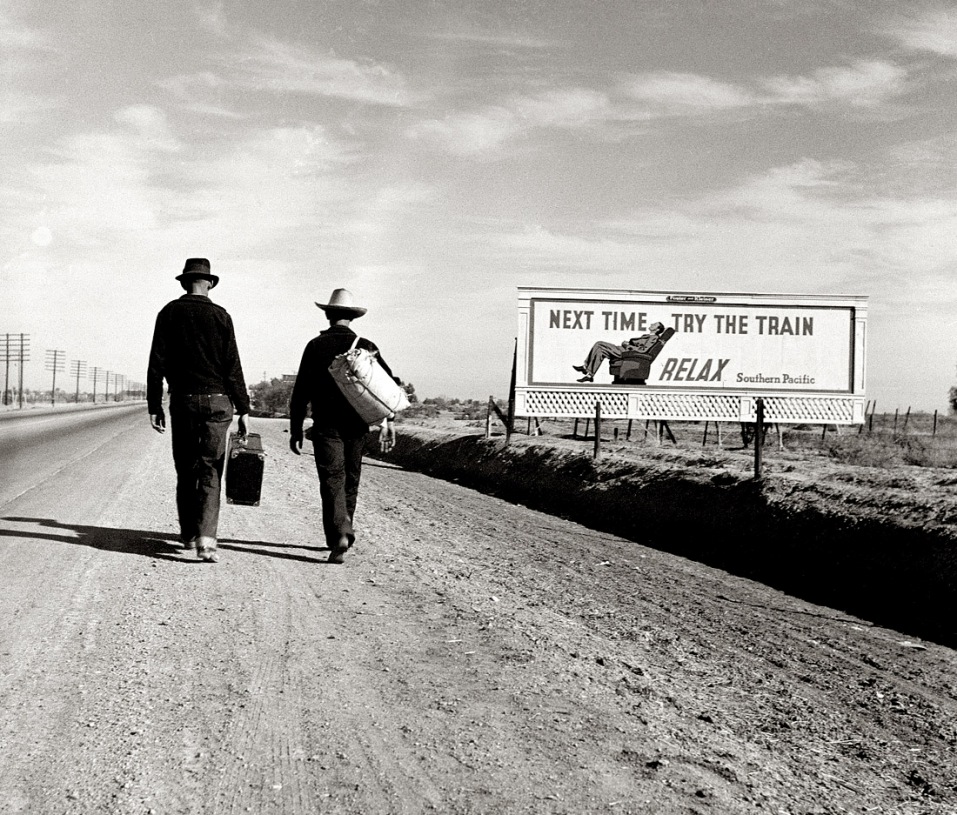
Dorothea Lange ‘Towards Los Angeles’ 1937
I have chosen this image as it captures a
number of aspects related to last week’s lecture and the course as well as
being a powerful and an image that is somewhat appealing to the eye.
The obvious power within this image is the
irony. At the left side of the image we see two men walking with luggage along
a long straight. This gives the viewer the impression that they are travelling
somewhere far by foot. The irony, of course, lies on the right side of the
image as a billboard reads ‘Next time try the train. Relax’. This is important
as it contrasts the other side of the picture. Dorothea Lange was iconic in
capturing images of the depression and this is a somewhat different take on her
other work which often pulls on the heartstrings and is much more raw. The fact
that these two men must walk all the way to Los Angeles rather than take the
train plays well to the idea of Depression photography. The men clearly do not
have the funds to be able to afford to use the train and so must walk to Los
Angeles.
This image is also interesting as it plays
into ideas of the American Dream and the perfect victim, as Lawrence Levine
writes about in his article. It plays on ideas of the American Dream with the
idea of new found wealth in a new found country. This is because the railroads
were still a relatively new invention that were mainly used by more privileged
members of society. While this wasn’t just for the rich and trains weren’t
particularly expensive, it is a luxury that many blue collar workers during the
depression would aspire to use-constantly seeking a self made wealth and
playing to the American Dream’s ethos of aspiration and social mobility.
This also plays well to Levine’s idea of a
‘perfect victim’. This is the sense that imagery somewhat victimizes the people
who are captured but is also somewhat harmless as despite these Depression
images being very raw and emotional, it is simply a short insight for a purpose.
The people captured still went about their everyday lives. Levine writes, “they also continued, as people always must, the
business of living. They ate and they laughed, they loved and they fought, they
worried and they hoped … they filled their days, as we fill ours, with the
essentials of everyday living.” So despite these images somewhat being
exploitative at working class economic despair, in reality it is often the way
the image has been taken, background, and timing that convey this message
rather than the actual people. There’s no telling what the men’s distance is
away from Los Angeles or their economic status. It is only assumed by the
contrasting irony of the billboard, again reinforced by the caption of this
image, suggesting Los Angeles is somewhat of a distance away. This shows that
Dorothea Lange does somewhat play to that Perfect Victim illusion that Lawrence
Levine talks about.

No comments:
Post a Comment