Monday, 6 March 2017

Critical analysis of Ragged Dick

Gorman Beauchamp, 'Ragged Dick and the Fate of Respectability'

This article by Gormon Beauchamp talks about the formulaic way in which Alger wrote the novels in the Ragged Dick series, changing little things plot wise because they worked and it is what people wanted to read. I agree with the statement that his books were written with a strict set of guidelines and this is shown in the article when Beauchamp states that ‘at least a dozen Alger novels are not by Alger’ because after his death it was easy for his publisher to hire ghost writers to follow the same rules and reproduce similar stories. There is evidence to this formula as only two of Alger’s novels actually had a female protagonist. This is most likely because Alger’s main audience was young boys who could associate themselves with the characters in the novels and hopefully follow the same rags to riches lives of Alger’s protagonists.


John Swansburg, 'The Self-Made Man'

In this article by John Swansburg he talks about ‘self-made men’ like the boys in Alger’s novels such as ragged dick. He starts by talking about Benjamin Franklin who went from being poor and under harsh care by his brother to being one of the most famous scientists in the world.
In Franklins Autobiography, he talks about his life and it is shown that he, like the boys in Alger’s novels pulled himself up by his bootstraps from being penniless in Philadelphia. It is not as clear cut as just being able to help yourself though, as in Franklins life he already had knowledge of how printing worked which helped him get off the streets and was a large stepping stone in his life. This is similarly shown in Ragged Dick where external factors are shown to help the protagonist as well as him helping himself. Examples of this in the novel are when he gets a job as a Clerk because he saves a drowning boy. Were it not for the man offering him the job in his office he would have not been able to get such a respectable job.


Cara Erdheim, 'Why Speak of American Stories as Dreams'


Cara Erdheim’s article talks about shifting attitudes in the ‘American Dream’. This is shown in Ragged Dick through Dick’s aspiration in the novel to better himself to get better paying and more respectable jobs in order to escape his ‘old vagabond life’ which he subsequently does at the end of the novel. It is not clear whether Dick will keep on striving to be more and more successful or stay at the office as a clerk which raises questions but this open-endedness helps illustrate the point of Erdheim that the ‘American dream’ has shifting trends and is subjective.

Sunday, 5 March 2017

Beauchamp, Erdheim's and Swansburg's critical analysis of Ragged Dick.

The typical “rags to riches” storyline outlined by Horatio Alger in his many novels, specifically Ragged Dick, has led to speculations as to the authenticity of the reality of the ‘rags to riches’ within modern society.

John Swansburg speaks of this authenticity of an individual becoming successful within “Horatio Alger: The Bard of the Street Boys” in ‘The Self-Made Man’. Swansburg’s argument that Ragged Dick’s ‘attributes merely qualify the Alger hero for success; they don’t produce it’. Therefore, the whole ‘rags to riches’ of an individual succeeding is not so straight-forward. In order for the individual to become successful, he must be recognised for his personal traits and characteristics in order to become something of himself. This is seen clearly within Ragged Dick Chapter Three, with the counterfeit bill. Ragged Dick’s honesty as to whether the bill was counterfeit or not was not sufficient evidence for the store owner and therefore must seek external help from a man who was more successful than he was, which reinstates Swansburg’s argument that Dick has qualities that qualify for success but that it does not necessarily produce success itself.

Another argument that is particularly persuasive is within Cara Erdheim’s academic article, ‘Why Speak of American Stories as Dreams?’. Erdheim argues that the ‘American Dream’ which can be seen within the ‘rags to riches’ cliché of Alger’s books are ‘
the birth, death, and rebirth of the American Dream show that the narrative has a life cycle of its own’. Dick was primarily a shoeshiner within the novel, and due to his characteristics of honesty, and righteousness he is reborn as a successful man who has a job within a mercantile firm with the aid of others as mentioned previously. Erdheim’s argument is persuasive as it shows a shift in lifestyles and ambitions surrounding the American Dream. Was Ragged Dick’s ambitions seen as to become just successful and out of the poor area of the city or to be something more tangible? Will Dick continue to be successful and continue to rebirth as argued by Erdheim or will he remain to succeed his original ‘American Dream’?

In addition to this, Gorman Beauchamp voices their view on the subject but is unsuccessfully persuasive. Beauchamp argues that with the success of literature of Alger’s novels, ‘in the last decade of the nineteenth and the first decade of the twentieth century a vast proportion of America's youth, it appears, were buying, borrowing and swapping’ such novels between themselves’. However, in comparison to Horatio Alger’s characters within ‘Ragged Dick’ it is argued that being literate was only for those who were educated. In Chapter Twenty, Alger writes about how Dick’s ‘street education was sharp’ whereas his tangible literate skills were improving suggesting that there are two meanings behind being literate within society. By being literate translates to being respected by others and being successful and having a sufficient financial income whereas ‘street education’ was about having an understanding about how the lifestyle of the poor was and how to evade certain situations led to being respected within a niche circle.

To conclude, Horatio Alger’s ‘Ragged Dick’ does meet to the arguments defined by Swansburg, Erheim but argues the authenticity of Beauchamp’s argument as to how successful Alger’s novels were among American youth culture therefore, Beauchamp does not provide a persuasive argument as to overall lifestyle and culture within America and the ideals surrounding the American Dream itself.
Sources:

Alger Jr., H., Ragged Dick, (New York, W. W. Norton & Company Inc., 2007).

Beauchamp, G., 'Ragged Dick and the Fate of Respectability',

Erdheim, C., "Why Speak of American Stories as Dreams?" (2013). English Faculty Publications. Paper 19., http://digitalcommons.sacredheart.edu/eng_fac/19, (accessed 5th March 2017).


Swansburg, J., “Horatio Alger: The Bard of The Street Boys” in ‘The Self Made Man’, http://www.slate.com/articles/news_and_politics/history/2014/09/the_self_made_man_history_of_a_myth_from_ben_franklin_to_andrew_carnegie.html, (accessed 5th March 2017).

Monday, 27 February 2017

Final Confrontation With Scar

The scene I have chosen is probably the most harrowing scene in the film, which is when has his final confrontation with Scar. Ethan scalps Scar during the raid to save Debbie whilst the other men are fighting and then emerges from the tepee brandishing his scalp. This is not something you would expect a ‘cowboy’ like Ethan to do as it breaks down the wall which stopped him being one of the ‘savage’ Indians which he has been tracking down throughout the whole film because of their brutal attack on his brother’s home and the kidnap of his nieces.

The scene is quite a shock on first viewing of the film as scalping is an Indian tradition, and throughout the film Ethan is shown to have a deep hatred for the Indians. his violent nature towards them is shown early on when he shoots the eyes out of a dead Indian because in their belief it means they will be forced to roam the world forever.

This hatred for Indians also almost led him to shooting his niece, Debbie, when she said that she was not coming back with them. He held the same belief that was shown earlier on when he found some women who had been rescued and said that they were ‘no longer white’. Ethan seems to hold the belief that the only good Indian is a dead one which would be seen today as extremely racist.

He goes against moral cowboy codes frequently in the film such as shooting at retreating enemies and in the raid scene running down a woman on his horse who appears to be holding a baby. His character is extremely complex in this regard as he will happily break moral values to harm Indians, yet he himself holds some Native American values. He appears to be able to speak several native languages and he himself is a scalper. The film clearly plays on Ethan’s ‘Indianness’ in several ways but most notably is the mirroring between him and Scar. Both men are strong characters, and whilst Scar is obviously intended to be the villain of the film, Ethan is by no means a hero and if not kept in check by Martin he would be cast in a totally different light.

This scene shows a shift in the western genre and perceptions about cowboys. It shows that both cowboys and Indians are united in several ways through their violence and their shared culture. The irony of the raid scene is that it mirrors the attack on the house at the beginning of the film, painting the picture that the white men are no better than the Indians throughout the film as both have been shown to partake in particularly heinous crimes and both parties could have been pushed to this by the illusion of revenge.


I chose this scene because it is a reflection on the attack on the house at the beginning but this time the viewer is behind the actions of the attackers even though they are still committing terrible acts in the same way as before, when the viewer was shocked by the attack on Ethan’s family. The film as a whole challenges stereotypical views towards the American west in many ways and the main character Ethan is not portrayed as a good person throughout yet he is who the viewer is behind throughout.

Friday, 24 February 2017

The Raid to Rescue Debbie

In this scene, we see the Comanche camp of tepees, this is well-known iconography of the Native Americans in the western genre. Along with the tepees we see the hides of animals, skulls of animals they have successfully killed, and blankets with typically Native American designs. The Natives are also dressed as we expect them to be dressed. They have elaborate headpieces, long dark hair secured in plaits, and the men aren’t wearing any tops. This suggests that they are ‘uncivilised’ compared to the rangers who are fully clothed, complete with jackets and hats.

By scalping Scar, Ethan breaks from the generic conventions of the western, in that it is common for the natives to scalp westerners to deter them from crossing them. Instead, we see a westerner scalping a native, this makes us question Ethan’s attitude towards being a Cowboy. We also see Ethan and the other rangers challenging the Cowboy Codes that Gene Autry created. By charging in guns blazing, they break the first code that, “the Cowboy must never shoot first, hit a smaller man, or take unfair advantage.” The Natives shoot back at them in defence, this is justifiable as they were attacked.


By charging into the natives’ camp, we see a symbolisation of the idea that the Wild West will be tamed by civilisation. The rangers (a group enforcing the law), are punishing the tribe for the capture of Debbie, and as such they are ‘justified’ in their actions. However, we also see that they go too far. This is shown when they have charged through the camp, and they turn to charge again, unnecessarily, on the Captain’s orders. It is interesting that the Captain is also the Reverend. As a Reverend you would expect him to be tolerant of others and averse to violence. Yet here we see him leading a charge and potentially wounding women and children. 

Thursday, 23 February 2017

Ethan saves Debbie in 'The Searchers'

Within the film ‘The Searchers’, the storyline of retrieving Debbie from the Comanche tribe proves to have an impact not only for the supporting characters (such as Mr and Mrs Jorgensen’s family) but also Ethan, the protagonist.

The stereotypical viewpoint of the American West and its portrayal within cinematography is challenged throughout the film. As Frederick Jackson Turner’s hypothesis suggests that the ‘experience of the frontier and the expansion West leads to a memory of civilisation advancing which met declining savagery’ was a primary factor that contributed to the stereotypical cowboy vs Native Indian films,, we do not see this clearly within this film.

Although Ethan respects their rituals and beliefs to an extent, which is seen clearly when shooting the recently deceased tribe member between the eyes, disturbing his journey onto the next life and leaving him to “remain wandering forever between the winds”. However, this goes against the stereotype of the American West identity being seen as expanding West and introducing the Comanche tribe to a mass civilisation instead of a ‘savage’ lifestyle, which is also not the main focal point. His reasoning for going against the tribe is to retrieve Debbie from them after she was kidnapped by the tribe leader.

Upon realisation that Debbie has in fact become part of the tribe and accepted her new way of life and does not wish to return home with him at first, Ethan deems her as ‘She ain’t white’ due to the disgust of integrating herself with the Comanche. This questions the myths of American West lifestyle of the man always ‘rescuing’ the women whereas in this case the woman does not wish to be rescued at all, or at least for now within the film.

In relations to Gene Autry’s ‘Cowboy Code’, he goes against these so-called commandments of ‘respecting women, parents, and his nation’s laws’ and instead follows his own ideas and intentions by rescuing Debbie regardless as to whether she is actually a ‘person in distress’.

Following this, as the film concludes, we see that Ethan rescuing Debbie after successfully wounding and killing members of Scar’s tribe and picks her up as seen in the still image (above). By fulfilling his duty of retrieving Debbie without force and instead picking her up in his arms above his head, it can suggest that it was a personal remembrance that overshadows his own views of murdering her due to going against his beliefs of Debbie becoming one of the tribes woman and instead remembering her as if she were the little girl he looked after all the years before this occurred and takes her home in his arms to Mr and Mrs Forgensen.


Source:
Autry, G., ‘Cowboy Code’, http://www.geneautry.com/geneautry/geneautry_cowboycode.html, 23rd February 2017.
The Searchers, John Ford, C.V. Whitney Pictures, 1956.
Pippin, R. B., “What is a Western? Politics and Self Knowledge in John Ford’s ‘The Searcher’s’”, The University of Chicago Press, (2008).

Monday, 20 February 2017

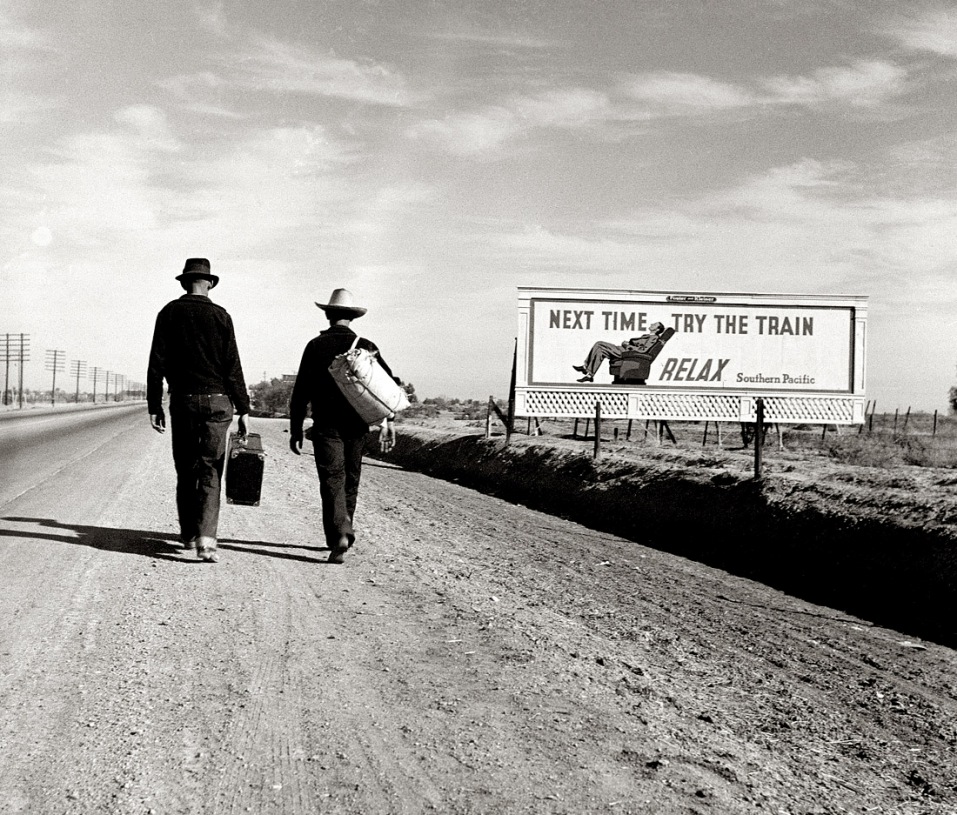
Dorothea Lange-Towards Los Angeles


Dorothea Lange ‘Towards Los Angeles’ 1937

I have chosen this image as it captures a number of aspects related to last week’s lecture and the course as well as being a powerful and an image that is somewhat appealing to the eye.

The obvious power within this image is the irony. At the left side of the image we see two men walking with luggage along a long straight. This gives the viewer the impression that they are travelling somewhere far by foot. The irony, of course, lies on the right side of the image as a billboard reads ‘Next time try the train. Relax’. This is important as it contrasts the other side of the picture. Dorothea Lange was iconic in capturing images of the depression and this is a somewhat different take on her other work which often pulls on the heartstrings and is much more raw. The fact that these two men must walk all the way to Los Angeles rather than take the train plays well to the idea of Depression photography. The men clearly do not have the funds to be able to afford to use the train and so must walk to Los Angeles.

This image is also interesting as it plays into ideas of the American Dream and the perfect victim, as Lawrence Levine writes about in his article. It plays on ideas of the American Dream with the idea of new found wealth in a new found country. This is because the railroads were still a relatively new invention that were mainly used by more privileged members of society. While this wasn’t just for the rich and trains weren’t particularly expensive, it is a luxury that many blue collar workers during the depression would aspire to use-constantly seeking a self made wealth and playing to the American Dream’s ethos of aspiration and social mobility.


This also plays well to Levine’s idea of a ‘perfect victim’. This is the sense that imagery somewhat victimizes the people who are captured but is also somewhat harmless as despite these Depression images being very raw and emotional, it is simply a short insight for a purpose. The people captured still went about their everyday lives. Levine writes, “they also continued, as people always must, the business of living. They ate and they laughed, they loved and they fought, they worried and they hoped … they filled their days, as we fill ours, with the essentials of everyday living.” So despite these images somewhat being exploitative at working class economic despair, in reality it is often the way the image has been taken, background, and timing that convey this message rather than the actual people. There’s no telling what the men’s distance is away from Los Angeles or their economic status. It is only assumed by the contrasting irony of the billboard, again reinforced by the caption of this image, suggesting Los Angeles is somewhat of a distance away. This shows that Dorothea Lange does somewhat play to that Perfect Victim illusion that Lawrence Levine talks about.

Christmas Dinner in Iowa - 1936


This is a photograph taken by Russell Lee in Iowa in 1936. The image shows children crowded around a table in a small shack eating Christmas Dinner. I chose this image because it shows how the extreme poverty caused by the great depression meant that the children hardly had enough money and food for Christmas.

The image raises a lot of questions, such as where are the parents in the image and why are there empty chairs in the image. Many questions are answered in an article from Sioux city journal, where Helen Pauley Hopkins who is the child closest to the camera in the picture, is tracked down later in life and asked about the photograph.

In the article, Helen explains that her family barely had enough food and money to get by and as soon as they could the children found work. She talks about how she and her siblings used to wait for their father to return home from work each day to eat with him as a family. Looking back on her childhood retrospectively she realises that her parents went without regularly to make sure that the children ate well and had enough to survive in the depression. She also explains that she lost two siblings during the depression, one as a baby and one before the age of four. This could be why the parents put so much effort into making sure that the others had enough.

The image was probably taken without the parents in frame to focus on the struggle of children at the time, which is partially why the photo hits so hard. The conditions that the children are living in is equivalent to the hardships faced by many in modern day slums and the fact that this was taken in America less than a century ago shows just how hard hitting the crash was.

This also shows that the idea of the American Dream was stopped dead in its tracks by the Great Depression and instead of trying to achieve the perfect life for them and their families, many Americans were just living each day as it came in hopes of survival.